
Service providers are now increasingly responsible for safeguarding sensitive payment data across shared environments as cloud computing becomes integral to modern digital infrastructure. The Payment Card Industry Data Security Standard (PCI DSS) was made to protect cardholder data from breaches and fraud. It applies to any entity that stores and processes this data. Cloud service providers and managed service providers that operate in multi-tenant environments with multiple customers sharing infrastructure are collectively a part of this category. Scaling PCI DSS in multi-tenant architectures can be complex, since shared responsibility blurs accountability, and workloads are always evolving. Service providers, thus, need to adopt strategic and scalable approaches to compliance. This article discusses this further in greater detail to guide service providers.

Understanding PCI DSS Requirements for Service Providers
PCI DSS presents a deep set of security controls made to secure cardholder data throughout its lifecycle. These needs range across various domains, like network security and access control, as well as monitoring and encryption. Compliance is mandatory for service providers if their services affect or interact with a customer’s cardholder data environment (CDE).
Service providers also need to adhere to additional requirements in multi-tenant cloud environments, as defined in PCI DSS Appendix A1. The appendix particularly targets multi-tenant service providers. These requirements pay attention to the need for stronger tenant isolation and support for customer security testing. It is also about a clearer delineation of responsibilities.
An important part of PCI DSS compliance is the shared responsibility model. Cloud providers usually protect the underlying infrastructure while the customers remain responsible for protecting their applications and data. This division needs service providers to clearly document and communicate responsibilities so that no security control is ignored.
On top of this, compliance validation includes regular assessments by Qualified Security Assessors (QSAs), which result in an Attestation of Compliance (AOC). This process is consistent and needs ongoing monitoring along with remediation to adapt to evolving threats.
Challenges Of Achieving PCI DSS Compliance At Scale In Multi-Tenant Cloud Platforms
Let us have a look at the challenges of achieving PCI DSS compliance at scale in Multi-tenant cloud platforms:
Complexity Of Multi-Tenant Architectures
Multi-tenant cloud platforms are inherently complex. This is due to shared infrastructure and logical separation of customer environments. Service providers need to ensure that each tenant’s data is isolated, even across shared resources like servers and networks. PCI DSS clearly identifies such environments and imposes additional controls to ensure secure segmentation and data isolation.
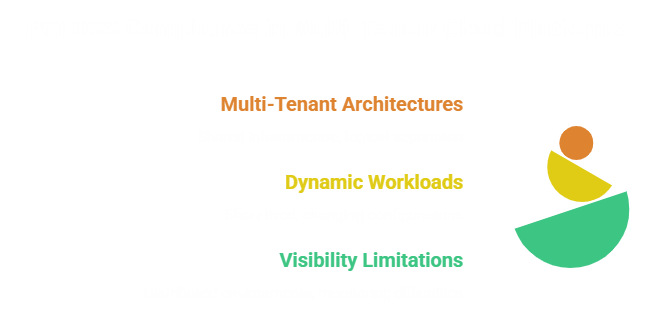
The challenge here is in the execution of an effective logical isolation mechanism that prevents data leakage or unauthorized access between tenants. Any misconfigurations or vulnerabilities in shared components can seemingly expose several customers at the same time. This increases the risk and impact of security incidents.
Dynamic & Ephemeral Workloads
Modern-day cloud environments depend greatly on dynamic workloads. These include containers and microservices, as well as auto-scaling systems. These workloads are usually short-lived and keep changing. This makes it harder to maintain security configurations and compliance controls.
However, PCI DSS needs stable and well-documented security measures. The ephemeral state of cloud-narrative applications can lead to configuration drift. Here, systems slowly deviate from their compliant state. Service providers need to, hence, execute automated mechanisms to enforce compliance continuously, regardless of workload volatility.
Visibility & Control Limitations
Getting full visibility across distributed cloud environments is another important challenge. Multi-tenant platforms usually span multiple regions and services, as well as layers. This makes it harder to monitor all activities and detect anomalies in real time.
PCI DSS mandates intensive logging and monitoring, along with audit trails. These are to detect and respond to security incidents. Even so, collecting and correlating logs from diverse sources in large-scale environments can be complex. Service providers may struggle to demonstrate compliance or identify potential threats before they escalate if they do not have centralized visibility.
Designing a PCI DSS-compliant Multi-tenant Cloud Architecture
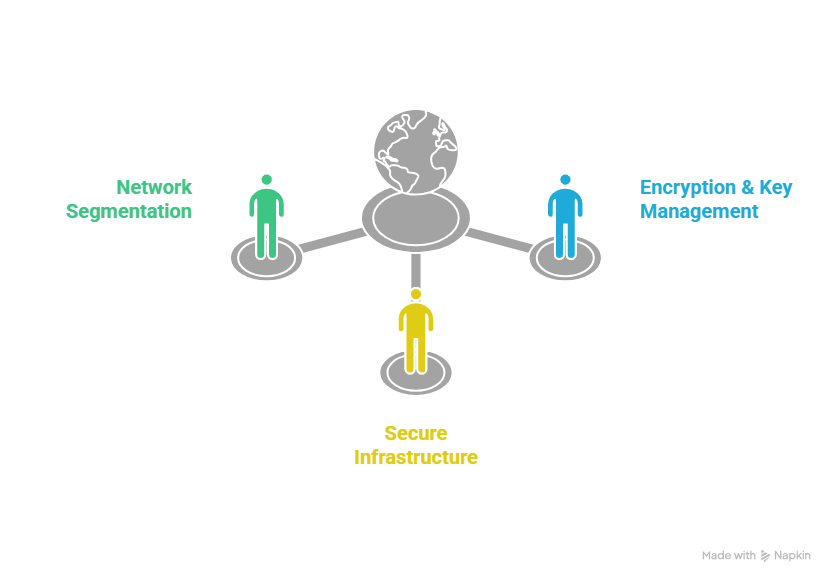
Here is how to set about designing a PCI DSS-compliant multi-tenant cloud architecture:
Network Segmentation & Tenant Isolation
Effective network segmentation is the foundation of PCI DSS compliance. Service providers need to isolate the cardholder data environment from other systems to lessen the scope of compliance and minimize risk. This can be brought to fruition with virtual networks and firewalls, as well as micro-segmentation techniques.
Segmentation needs to be consistently validated to ensure its effectiveness, especially after system changes. Proper isolation enhances security while also simplifying compliance by limiting the systems that fall within scope.
Secure Infrastructure Configuration
A secure foundation is important for compliance. Service providers need to execute hardened configurations for all infrastructure components, like servers and containers, as well as networking devices. This includes disabling unnecessary services and applying security patches on time, as well as sticking to secure configuration baselines.
It can be challenging to maintain consistent configurations across large-scale environments, especially in versatile cloud settings. However, standardized templates and infrastructure-as-code can help create security policies uniformly.
Encryption & Key Management
Encryption plays an essential role in safeguarding cardholders at both rest and in transit. PCI DSS needs strong cryptographic controls and secure key management practices to prevent unauthorized access.
Service providers must focus on encryption keys being stored securely while being rotated regularly and becoming accessible only to authorized personnel. Hardware security modules and cloud-native key management services can enhance the security of cryptographic operations while simplifying compliance.
Implementing Scalable Security Controls
Next up, implementing scalable security controls comes into play for multi-tenant environments:
Identity & Access Management (IAM)
Identity and access management are crucial to PCI DSS compliance. Service providers should enforce strict access controls to ensure that only authorized individuals can access sensitive data. This involves the execution of role-based access control (RBAC) and enforcing least privilege principles, as well as strong authentication mechanisms like multi-factor authentication.
Proper IAM practices are also about managing user identities throughout their lifecycle through provisioning and monitoring. There also needs to be revocation of access when no longer needed. These controls ensure there are no inside threats.
Automated Compliance Enforcement
Manual compliance processes are not scalable in large cloud environments. Service providers must go for automation to enforce security policies and maintain compliance consistently.
Policy-as-code and infrastructure-as-code approaches allow service providers to put forth compliance requirements programmatically. This ensures that all resources are deployed and maintained in a compliant manner.

Leveraging Automation For Compliance At Scale
Leveraging automation for compliance at scale in multi-tenant environments is the subsequent step:
Automated Configuration Management
Automation is needed to maintain consistent configurations across multi-tenant environments. Configuration management tools can set up security baselines and detect deviations, as well as automatically remediate non-compliant systems.
Continuous Compliance Monitoring
Continuous compliance monitoring allows service providers to assess their security position in real time. Automated tools can evaluate systems against PCI DSS requirements to generate compliance reports and provide actionable insights. This approach matches the PCI DSS requirements for continuous assessment and remediation. Service providers can maintain a constant state of compliance instead of relying only on periodic audits. This reduces the chances of audit failures.

Maintaining PCI DSS Compliance Over Time
What follows is maintaining PCI DSS compliance over time in multi-tenant environments:
Regular Audits & Assessments
PCI DSS compliance is an ongoing process instead of being a one-time achievement. Service providers need to undergo regular audits and assessments to validate their compliance status. These assessments are usually held by Qualified Security Assessors who look into an organization’s security controls and issue an Attestation of Compliance.
Regular audits help find the gaps in security and ensure that compliance measures are as effective, even if the systems are evolving. They also give the assurance to customers and stakeholders that the service provider meets industry standards.
Documentation & Reporting
Accurate documentation is important for showing compliance. Service providers are advised to maintain detailed records of security policies and procedures, while retaining evidence of their implementation.
Reporting is just as important. It gives transparency to customers and regulators. Clear documentation of responsibilities and controls helps build trust.

Best Practices For Multi-tenant Cloud Compliance
These are the best practices for multi-tenant cloud compliance:
Standardized Security Across Tenants
Standardizing security controls across all tenants helps ensure consistency. It even reduces the risk of gaps in protection. Service providers should execute uniform policies and configurations that apply to all customer environments.
Educating Customers On Shared Responsibility
The shared responsibility model is an important aspect of cloud security. Service providers require educated customers who know about their roles and responsibilities in maintaining compliance.
Leveraging Compliance-ready Cloud Services
Several cloud providers give services that are already validated for PCI DSS compliance. This gives a strong base for creating secure applications.

Conclusion
It is a complex but important undertaking for service providers to both achieve and maintain PCI DSS compliance at scale in multi-tenant cloud platforms. Understanding the unique challenges and pathways to come to this compliance is, thus, crucial. This article showed everything from limitations to best practices that can help service providers in their compliance journey. For organizations that require simpler PCI DSS compliance while strengthening their cloud security posture, Matayo AI provides it all. Their expert-led compliance consulting and VAPT services, along with continuous security solutions made for modern multi-tenant environments.