
In this high-risk digital environment, clients look for an evidence-based security framework before they make any investments or initiate partnerships. That is when SOC certification is a key choice for security companies, especially SaaS and tech-oriented businesses. Although both Type I and Type II certifications follow the same Trust Services Criteria, they have very different customer expectations. Type I assesses whether controls are designed correctly at a particular point in time, whereas type II demonstrates that controls maintain consistency and effectiveness over several months. Knowing what certification your customers really desire can directly affect trust, sales cycles, and long-term credibility.
What are SOC 2 Type I and SOC 2 Type II certifications?
SOC 2 Type 1 compliance verifies the cybersecurity controls of an organization at one point. The aim is to find out whether the internal controls that are implemented to protect customer data are adequate and effective. Type I audits and reports take a few weeks to be completed. A SOC 2 Type 2 gives information about your security controls and evaluates their efficiency based on a time span, which typically ranges between three and twelve months. The SOC 2 Type 2 certification will give more details of the effectiveness of those controls. This is why a SOC 2 Type 2 is more extensive and demonstrates the trustworthiness of your systems. A SOC 2 Type 2 audit of your company is performed over an extended period of time. Contrary to a SOC 2 Type 1 audit, the audit process will be more costly and probably further time-consuming.
Basic Differences between SOC 2 Type I and Type II
The fundamental variations between Type I and Type II SOC 2 are as follows.
| Aspect | SOC 2 Type I | SOC 2 Type II |
| Purpose | Determines the status of security controls being designed appropriately. | Test the design and operational effectiveness of controls. |
| Time Frame | Evaluated at a single point in time | Evaluated after 3 -12 months |
| Depth of Review | Concentrates exclusively on control design. | Concentrates on the longitudinal performance of controls. |
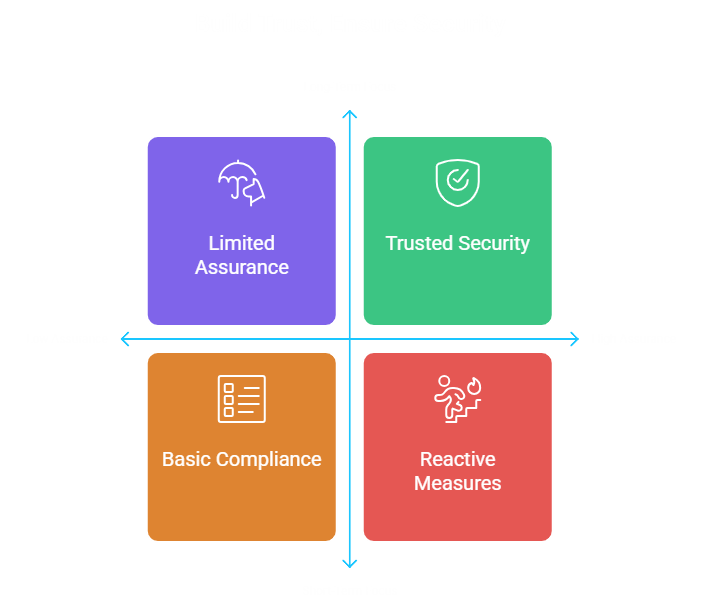
| Level of Assurance | Provides limited assurance | Offers greater trust and confidence |
| Audit Effort | Quick and less complicated to do. | Further elaborated and paperwork-intensive. |
| Customer Expectation | Appropriate in early-stage/growing firms. | Favored by the company and controlled by customers. |
| Business Impact | Assist in establishing security trust. | Enhances customer loyalty and new sales. |
Does SOC 2 Type I Still Work?
Type I has not entirely been phased out yet, especially in organizations that are young or fast-growing. It is sometimes the correct decision when you:
- Have to demonstrate improvement to investors or customers in a short time.
- Prefer a lighter audit while you prepare for the Type II process, which takes time.
- Leveraging readiness assessment to determine control gaps prior to a full Type II
Consider it a gap analysis in disguise: it points out the deficiencies prior to your official examinations on a more protracted basis.
Type I report, however, is the starting line in reality. The finish line is SOC 2 Type II, for most cloud service providers, third-party vendors, and organizations with more than 50 employees dealing with financial or confidential data.
Why are customers more inclined toward SOC 2 Type II security compliance?
Customers are more security-conscious than ever. They are not dependent on promises and policies anymore because the risk of data breaches, regulatory pressure, and third-party risks is increasing. That is why SOC 2 Type II security compliance is highly preferred in organizations. In contrast to the simple security statements or point-in-time testing, the SOC 2 Type II offers evidence that can be sustained and independently tested that an organization is capable of safeguarding sensitive information over the long term. The following are the reasons why the customers appreciate SOC 2 Type II so much.
Depth of Evidence
Among the strongest arguments customers will make in favor of SOC 2 Type II is the efficiency level of evidence. SOC 2 Type II assesses the performance of security controls in the long run, usually for six to twelve months. This constant evaluation demonstrates that policies do not exist only on paper but are applied in practice regularly.
Whether it is the access controls and data encryption, incident response, and change management, auditors read logs, reports, and operational records over time. This depth will help customers to be reassured that security controls are not short-term arrangements that have been established merely to conduct an audit. They are rather mature, repeatable processes that are integrated into daily operations. To customers who are dealing with sensitive or controlled information, such assurance goes a long way in minimizing perceived risk.
Independent Assessment
Another significant factor that customers can trust about SOC 2 Type II is its independent assessment. A licensed third-party auditor issues the report and adheres to high professional standards. This autonomy eliminates prejudice and confirms that security assertions are legitimate and objective.
Internal security statements, marketing statements, or self-reported compliance checklists are getting more scrutinized by customers. In SOC 2 Type II, uncertainty is substituted by a neutral assessment performed by professionals who examine controls, evidence, and certify compliance with accepted Trust Services Criteria. This external accreditation simplifies customer defense of the vendor choice decisions within their company, and meets their own directives or procurement needs.
Assurance of Protection
Type II of the SOC 2 provides the customer with a better level of protection assurance than Type I. Customers can be assured of the ability of security practices to meet real-life operational pressures because controls are tested during a specified timeframe.
This guarantee is not limited to technology; it also considers people and processes, including onboarding of employees, role assignments, incident response policies, and vendors. Customers are aware that protection goes beyond firewalls and encryption and that protection has governance and accountability on all levels of the organization. Consequently, they will be more at ease leaving long-term data, integrations, and business operations with a SOC 2 Type II-compliant provider.
Confidence and Growth
To customers, SOC 2 type II compliance helps build confidence and growth. With mature security practices, customers experience fewer internal objections, quicker approvals, and easier contract negotiations. Such trust usually generates more partnerships and usage of services.
SOC 2 Type II is a vendor requirement that is needed by many enterprises, financial institutions, and healthcare organizations. Selecting a compliant provider assists the customers in scaling safely without always reevaluating the security threats. It also enables them to expand their personal enterprise without breaking the regulatory or industrial laws and to boost investors’ hope and customer confidence. This is how SOC 2 Type II will not only be an indicator of security but also a growth enabler.
Recovery and Reassurance
No system is immune to incidents, and customers are aware of this. What they seek is the recovery and reassurance capability of the organization. This includes fast identification of problems, acting promptly, and recuperating without significant interference. The SOC 2 Type II emphasizes incident response, monitoring, business continuity, and disaster recovery controls.
The validation of these core competencies has led to SOC 2 Type II effectiveness for organizations to assure their customers of handling unforeseen circumstances. These established procedures include detecting threats, communicating openly, and recovering. This assurance lowers the anxiety of worst-case scenarios and builds long-term trust even in risky situations.
Conclusion
In the contemporary risk-resistant business world, customers no longer desire just security on the surface but rather sustained, demonstrated security. SOC Type I is good, but Type 2 is better making it an ideal option to choose. SOC 2 Type II provides a more profound assurance, independent checks, and the reliability of the controls over time to build user trust. It will give them clear assurance that the data is being used responsibly, incidents are managed, and business growth will not affect the security. Companies that need to address increasing customer demands and speed up enterprise adoption have to collaborate with an expert compliance professional. Matayo offers SOC 2 Type II compliance automation, expert guidance, and support, making it possible to get to compliance much faster and establish long-term customer confidence in businesses.