
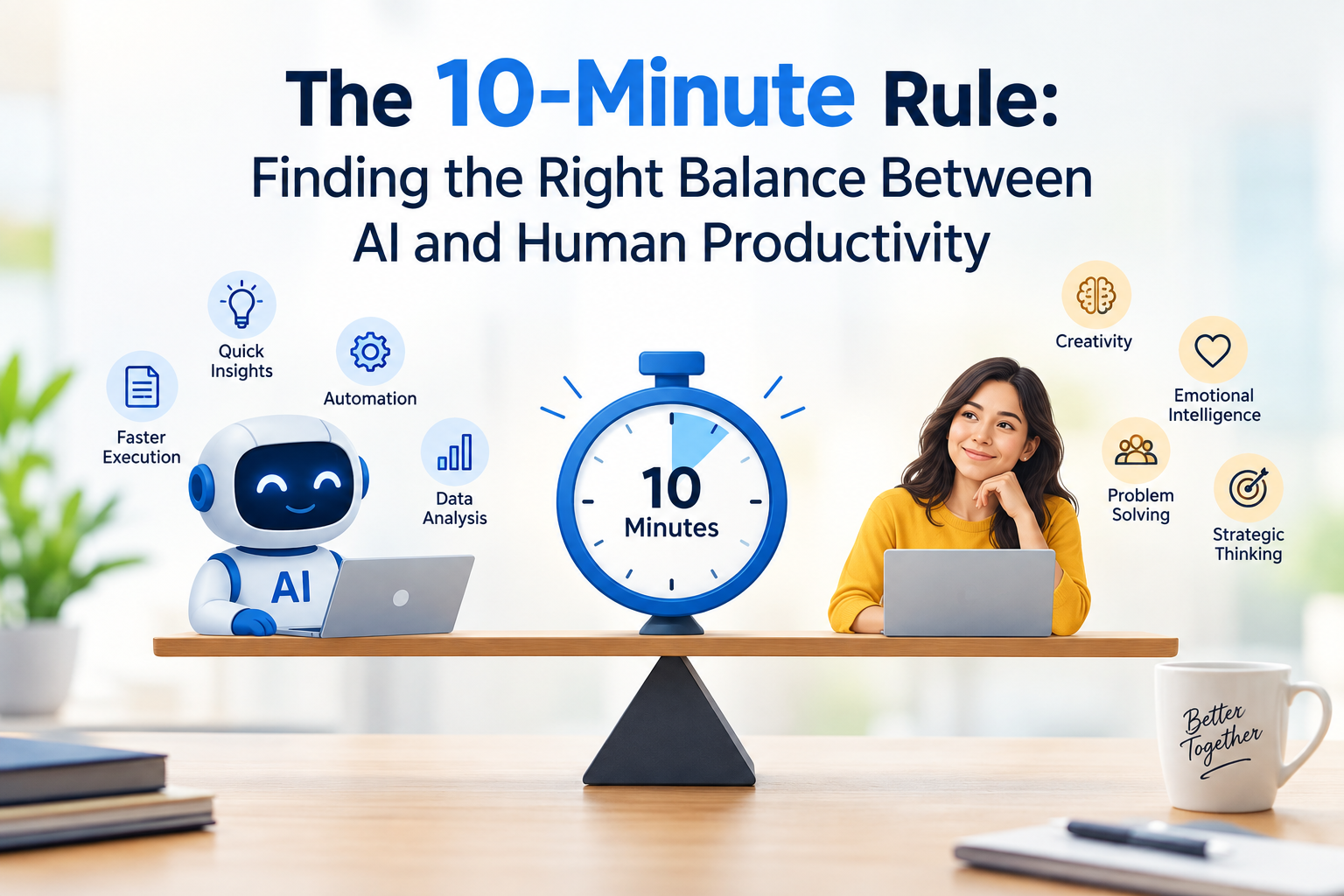
Introduction: A Pause That Changes Everything
Artificial Intelligence (AI) has become a defining force in modern productivity. From automating repetitive tasks to generating creative drafts, AI is reshaping how we work. Yet, with this power comes a challenge: how do we ensure that humans remain at the center of meaningful decision-making, creativity, and empathy?
The 10-Minute Rule offers a practical framework. It suggests that before starting any task, we pause for ten minutes to evaluate whether AI or human effort is better suited for the job. This reflection prevents blind reliance on automation and ensures that human strengths are preserved.
Part I: Understanding the 10-Minute Rule
What It Means
The 10-Minute Rule is not about micromanaging time but about strategic allocation of effort. In essence:
- Spend ten minutes analyzing the task.
- Ask: Can AI handle this faster without losing quality?
- If yes, delegate to AI.
- If not, keep it human-led.
This small pause creates a big impact by aligning efficiency with judgment.
Why Ten Minutes?
Ten minutes is long enough to think critically but short enough to avoid analysis paralysis. It’s a buffer that forces intentionality in how we use AI.
Part II: When AI Excels
Data Analysis
AI thrives on large datasets. It can process millions of rows in seconds, identify correlations, and generate predictive models. For example, financial analysts use AI to detect fraud patterns that humans might overlook.
Routine Tasks
Scheduling meetings, sending reminders, and managing repetitive documentation are perfect candidates for automation. These tasks drain human energy but add little strategic value.
Content Drafting
AI can generate first drafts, summaries, and brainstorming ideas. Writers often use AI to overcome creative blocks, then refine the output with their own voice.
Part III: Where Humans Must Lead
Decision-Making
Ethical dilemmas, leadership choices, and strategic planning require human judgment. AI can provide data, but it cannot weigh values or foresee cultural consequences.
Creativity
While AI can mimic styles, true originality comes from human imagination. Storytelling, art, and innovation rely on emotional resonance that machines cannot replicate.
Relationship Building
Trust, empathy, and communication are inherently human. Whether in customer service or leadership, relationships thrive on authenticity.
Part IV: Benefits of the 10-Minute Rule
- Efficiency: Tasks are completed faster when AI handles routine work.
- Focus: Humans concentrate on meaningful, high-value contributions.
- Sustainability: Prevents burnout by offloading repetitive tasks.
Part V: Practical Applications
Business Reports
AI generates charts and summaries; humans interpret results and craft narratives.
Healthcare
AI assists in diagnostics; doctors provide empathy and ethical judgment.
Education
AI personalizes learning paths; teachers inspire and mentor students.
Part VI: Challenges and Risks
Over-Reliance on AI
Blind trust in automation can lead to errors. For example, AI-generated financial forecasts may miss cultural or geopolitical nuances.
Ethical Concerns
Delegating sensitive decisions to AI raises questions about accountability.
Skill Atrophy
If humans outsource too much, critical thinking and creativity may weaken.
Part VII: Implementing the 10-Minute Rule
- Pause before starting a task.
- Evaluate whether AI or human effort is better.
- Delegate accordingly.
- Review outcomes to refine future decisions.
This cycle ensures continuous improvement.
Part VIII: Case Studies
Corporate Example
A consulting firm adopted the 10-Minute Rule for project management. AI handled scheduling and data crunching, while consultants focused on client relationships. Productivity rose by 30%.
Personal Productivity
A student used AI for summarizing research papers but wrote interpretations themselves. This balance improved both efficiency and learning outcomes.
Part IX: The Future of Human-AI Balance
The 10-Minute Rule is not static. As AI evolves, so will the boundaries of human and machine roles. The rule ensures adaptability by embedding reflection into daily workflows.
Conclusion: A Framework for Sustainable Productivity
The 10-Minute Rule is a compass in the age of AI. It reminds us that while machines can accelerate tasks, humans must remain the architects of meaning. By pausing for ten minutes, we safeguard creativity, empathy, and judgment while embracing efficiency.