
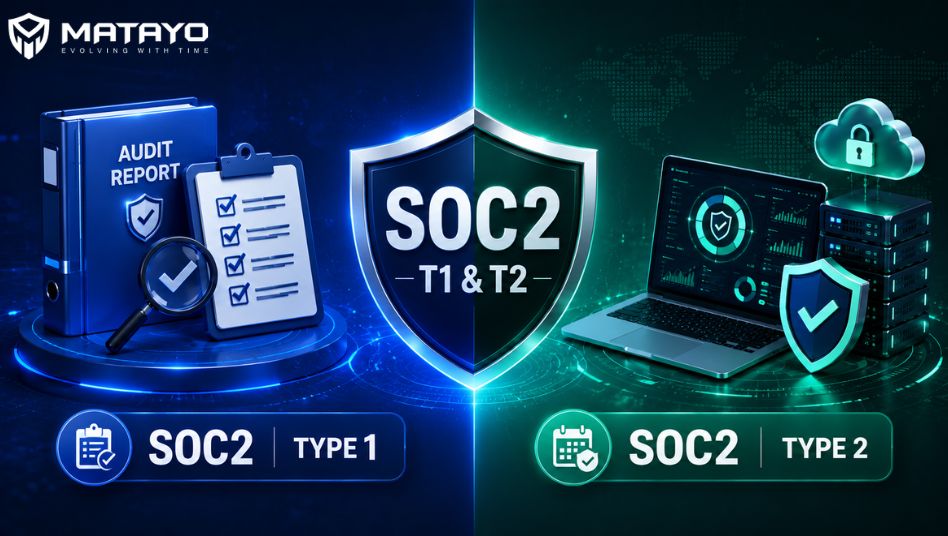
Every SaaS company preparing for its first serious enterprise deal eventually runs into the same question from a prospect’s security team: “Do you have a SOC 2 report?” What follows is usually a scramble to understand what SOC 2 actually requires, and more specifically, whether it’s smarter to start with SOC 2 Type I or go straight for SOC 2 Type II.
This isn’t a purely academic distinction. Choosing the wrong audit path can cost you months of runway, a failed sales cycle, or a report that looks good on paper but doesn’t actually satisfy the customer asking for it. This guide walks through SOC 2 Type II vs Type I in practical terms — what each one proves, when skipping Type I makes sense, when it backfires, and how to build a readiness plan that fits your company’s stage.
1. What Is SOC 2?
SOC 2 (System and Organization Controls 2) is an attestation framework developed by the AICPA (American Institute of Certified Public Accountants) to evaluate how a service organization manages customer data. Unlike a certification such as ISO 27001, a SOC 2 report is an independent auditor’s opinion, issued after examining your organization’s controls against the AICPA Trust Services Criteria: Security, Availability, Processing Integrity, Confidentiality, and Privacy.
Security is the only criterion required in every SOC 2 engagement; the rest are chosen based on what your product does and what your customers care about. A payments platform will likely include Processing Integrity. A healthcare SaaS product will almost certainly include Privacy and Confidentiality.
SOC 2 reports come in two forms, and this is where the Type I vs Type II decision comes in.
2. Understanding SOC 2 Type I
A SOC 2 Type I report answers one question: are your security controls designed appropriately, as of a specific date? The auditor reviews your policies, technical safeguards, and control descriptions, then issues an opinion on whether those controls, if operating as described, would be suitable to meet the relevant Trust Services Criteria.
Think of it as a snapshot. It confirms the architecture of your security program is sound on the day of the review — it does not confirm that the controls have actually been followed consistently over time.
3. Understanding SOC 2 Type II
A SOC 2 Type II report goes further. It covers an observation period — typically three, six, or twelve months — during which the auditor tests whether your controls were not just designed correctly but actually operating effectively throughout that window.
This means evidence collection: access logs, onboarding and offboarding records, change management tickets, incident response records, vendor risk assessments, and more, gathered continuously rather than reviewed once. Type II is widely regarded as the more meaningful report because it demonstrates sustained discipline, not a one-day performance.
4. Key Differences Between Type I and Type II
- Point in time vs. period of time: Type I is a snapshot; Type II tracks a window of operation.
- Evidence depth: Type I relies on control design documentation; Type II relies on operational evidence gathered continuously.
- Buyer perception: Type I signals “we’re getting there.” Type II signals “we’ve proven this works.”
- Audit effort: Type II demands ongoing evidence collection and continuous monitoring, not a one-time review.
- Risk of findings: Type II can surface exceptions that only show up over time, such as an offboarding step that was missed once.
5. Comparison Table: SOC 2 Type I vs Type II
| Factor | SOC 2 Type I | SOC 2 Type II |
| What it measures | Control design at a single point in time | Control design and operating effectiveness over a period |
| Typical duration | 4–8 weeks after readiness | 3–12 month observation window plus fieldwork |
| Evidence required | Policy and design documentation | Continuous operational evidence and logs |
| Buyer confidence level | Moderate — shows intent and structure | High — shows sustained execution |
| Best suited for | First-time compliance, early-stage teams | Companies with 3+ months of consistent control operation |
| Relative cost | Lower | Higher |
6. Why Companies Usually Start with Type I
Most companies pursuing SOC 2 for the first time start with Type I for a simple reason: it produces a report faster. If a sales team is being asked for “any SOC 2 report” to unblock a deal, a Type I lets the company show progress within weeks rather than waiting a full observation period. It’s also a useful checkpoint — an early signal from the auditor about whether the control design has gaps before committing to months of Type II evidence collection.
7. Can You Skip SOC 2 Type I?
Yes. There is no requirement from the AICPA or from any customer that a Type I report must precede a Type II report. Many companies, especially those with a security-experienced founding team or an existing ISO 27001 program, go straight to Type II. The tradeoff is time: you won’t have any report in hand until the full observation period and fieldwork are complete, which can mean four to twelve additional months compared with getting a Type I report quickly.
8. When Skipping Type I Makes Sense
- Your security program has already been operating consistently for several months, with logging, access reviews, and change management already in practice.
- You have in-house security or compliance expertise (a CISO, security engineer, or experienced compliance manager) who can build controls correctly the first time.
- Your sales pipeline gives you enough runway to wait for a Type II report rather than needing something in customers’ hands immediately.
- You’re using a compliance automation platform that has already mapped and is monitoring your controls before the audit begins.
9. Risks of Going Directly to SOC 2 Type II
Skipping Type I is not free of risk. If your control design has gaps — a missing offboarding step, inconsistent access reviews, an incomplete vendor risk process — those gaps don’t just get flagged once. They can surface repeatedly across the entire observation window, generating multiple exceptions in your first-ever SOC 2 report. That’s a worse outcome than a Type I report with a few design notes to fix before starting the clock on Type II.
There’s also a sunk-cost risk: months into a Type II observation period, discovering a structural control gap can mean restarting the clock, since the flawed period can’t simply be edited after the fact.
10. Benefits of Starting with Type I
- Faster first report, useful for unblocking early enterprise deals.
- Lower financial and operational commitment before proving the control design works.
- A natural checkpoint to catch design flaws before the Type II clock starts.
- Builds internal muscle memory for evidence collection ahead of the more intensive Type II process.
11. Which Companies Should Choose Type I?
Type I tends to fit early-stage SaaS startups going through SOC 2 for the first time, companies without a dedicated security hire yet, and organizations under pressure to show a report quickly while still building out their control environment. It’s also a sensible choice for teams that are unsure whether their current control design has gaps.
12. Which Companies Can Go Straight to Type II?
Fast-growing companies with an established security function, businesses that already run ISO 27001 or a similar framework, and organizations backed by compliance automation tooling with months of monitoring data already in place are often well-positioned to skip Type I. Enterprise software companies re-entering the SOC 2 process after a lapsed report may also go straight to Type II if their controls never stopped operating.
13. Common Mistakes Organizations Make
- Starting the Type II observation period before access controls, logging, and offboarding processes are actually consistent.
- Treating SOC 2 as a one-time project instead of an ongoing operating discipline.
- Choosing Trust Services Criteria that don’t match what customers are actually asking about.
- Underestimating the evidence collection burden on engineering and IT teams during the observation window.
- Assuming a Type I report will satisfy an enterprise customer that specifically asked for Type II.
14. Readiness Checklist Before Type II
| Readiness Area | What to Confirm |
| Access management | Onboarding, offboarding, and periodic access reviews are documented and consistently followed |
| Change management | Code and infrastructure changes go through a documented approval and testing process |
| Risk assessment | A formal risk assessment has been completed and is reviewed on a regular cadence |
| Security policies | Written policies exist, are approved, and are communicated to staff |
| Vendor management | Third-party vendors are risk-assessed and monitored |
| Incident response | A documented incident response plan exists and has been tested |
| Monitoring | Continuous monitoring or logging tools are in place and generating usable evidence |
15. Timeline for Both Audit Types
| Stage | SOC 2 Type I | SOC 2 Type II |
| Readiness assessment | 2–4 weeks | 2–6 weeks |
| Gap remediation | 2–6 weeks | 4–8 weeks |
| Observation period | None (point in time) | 3–12 months |
| Auditor fieldwork | 2–4 weeks | 4–6 weeks |
| Total time to report | ~2–3 months | ~5–14 months |
16. Cost Comparison
| Cost Component | SOC 2 Type I | SOC 2 Type II |
| Readiness consulting | Lower — shorter engagement | Higher — extended evidence support |
| Audit firm fees | Lower — single-point review | Higher — multi-month testing |
| Compliance automation tooling | Optional | Strongly recommended |
| Internal staff time | Moderate, concentrated | Higher, spread across the observation window |
17. Real-World Scenarios and Examples
Early-stage SaaS startup: A 15-person startup closing its first enterprise deal typically starts with Type I to get a report in front of procurement quickly, then begins the Type II observation period once the deal is signed.
Fast-growing AI company: An AI company already running strict access controls and audit logging for its own model security reasons may go straight to Type II, since much of the operational evidence already exists.
Healthcare SaaS: A healthcare platform handling patient data usually can’t afford design gaps discovered mid-audit, so many choose Type I first to validate the Security, Confidentiality, and Privacy criteria before committing to a long Type II window.
FinTech platform: A payments company under investor and regulatory pressure often needs to demonstrate Processing Integrity quickly, which pushes many toward Type I first, followed rapidly by Type II.
Enterprise software company: A company with an existing ISO 27001 certification and mature internal audit function frequently skips Type I entirely, since its control operating history already spans well beyond what a Type I review would confirm.
18. Industry Best Practices
- Run a formal readiness assessment before committing to either audit type.
- Use compliance automation to keep evidence collection continuous rather than a last-minute scramble.
- Choose Trust Services Criteria based on what your actual customers are asking for, not the maximum possible scope.
- Treat SOC 2 as an ongoing operating model, not a one-time audit event.
- Align control design with recognized frameworks such as ISO 27001 or NIST where possible, to reduce duplicate effort across compliance programs.
Common Myths About SOC 2 Type I and Type II
- Myth: You must complete Type I before Type II. Not true — Type II can be pursued directly.
- Myth: SOC 2 is a one-time certification. SOC 2 reports cover a specific period and generally need to be renewed annually to stay current with customers.
- Myth: A Type I report satisfies every enterprise customer. Many enterprise security teams specifically require Type II before signing.
- Myth: SOC 2 automatically satisfies HIPAA or GDPR. It can support those efforts but does not replace them.
- Myth: More Trust Services Criteria always looks better. Including criteria that don’t map to your product can add audit cost and complexity without adding real customer confidence.
Questions to Ask Before Choosing Your Audit Path
- How urgently do customers or prospects need a report in hand?
- Has our control environment been operating consistently for at least a few months?
- Do we have internal ownership for ongoing evidence collection, or will this fall on already-stretched engineering time?
- Which Trust Services Criteria actually matter to our customer base?
- Are we prepared for the possibility of exceptions appearing in a Type II report, and do we have a remediation story ready?
Frequently Asked Questions
Can a company skip SOC 2 Type I and go straight to Type II?
Yes. There is no rule requiring a Type I report before Type II. Many companies with mature security programs go straight to Type II, though it usually means a longer wait before the first report is in hand.
What is the main difference between SOC 2 Type I and Type II?
Type I evaluates whether controls are designed properly at a single point in time. Type II evaluates whether those same controls actually operated effectively over a review period, typically three to twelve months.
How long does a SOC 2 Type I audit take?
Typically four to eight weeks once controls are in place, since the auditor is only assessing a single point in time.
How long does a SOC 2 Type II audit take?
The observation window alone runs three to twelve months, plus several additional weeks for fieldwork and report issuance.
Is SOC 2 Type II more expensive than Type I?
Generally, yes. The longer observation period and greater evidence collection burden typically make Type II audits more costly than Type I.
Do enterprise customers accept a SOC 2 Type I report?
Some do as an interim signal of progress, but most enterprise procurement and security teams treat Type II as the report that actually satisfies vendor risk requirements.
What are the SOC 2 Trust Services Criteria?
Security, Availability, Processing Integrity, Confidentiality, and Privacy, as defined by the AICPA. Security is mandatory in every report; the rest are selected based on business need.
Is SOC 2 the same as ISO 27001?
No. SOC 2 is an attestation report common in North America, while ISO 27001 is an internationally recognized certification for an information security management system. Some organizations pursue both.
Does SOC 2 satisfy HIPAA or GDPR requirements?
Not on its own. It can incorporate relevant controls, but a SOC 2 report doesn’t by itself certify HIPAA or GDPR compliance.
What happens if controls fail during a SOC 2 Type II observation period?
The auditor documents the exception rather than stopping the audit. A few exceptions with a documented remediation response is common; a pattern across many controls is a bigger concern for prospects reviewing the report.
Conclusion
There’s no universal right answer to SOC 2 Type II vs Type I — the right path depends on how urgently you need a report, how mature your control environment already is, and how much risk you’re willing to take on a first-time audit. Early-stage teams generally benefit from the checkpoint that Type I provides. Companies with an established, well-documented security program can often move straight to Type II and save months on the overall timeline.
Whichever path you choose, the work that actually matters — access management, change control, risk assessment, continuous monitoring — is the same work either report is trying to verify. Getting that operating discipline right is what makes either audit type succeed.