
Why Compliance Fails
Compliance programmes often fail for predictable reasons:
- Treated as a one-time project: Compliance is not a checklist—it’s a continuous process.
- Manual processes: Spreadsheets and email-based tracking don’t scale and are error-prone.
- Siloed teams: Legal, security, IT, and product teams working in isolation.
- No clear ownership: When everyone is responsible, no one is accountable.
- Lack of evidence: If you can’t prove it, you didn’t do it.
- No continuous monitoring: Compliance drift goes undetected until audit time.
- Ignoring vendor risk: Your vendors’ failures are your failures under DPDPA.
What is a DPDPA Legal Register?
A Legal Register is a single source of truth mapping DPDPA requirements to your business processes, controls, and evidence.
Purpose
- Ensure all DPDPA requirements are identified
- Map requirements to specific controls
- Assign ownership and accountability
- Track review cycles
- Demonstrate compliance to auditors and regulators
Benefits
- Comprehensive coverage: No obligations missed
- Clear accountability: Every requirement has an owner
- Audit-ready: Evidence is organised and accessible
- Continuous improvement: Regular reviews drive maturity
Ownership
- Primary owner: Privacy Officer or DPO
- Contributing owners: Security, Legal, IT, HR, Product
Review Process
- Regular reviews (monthly/quarterly/annually)
- Updates when regulations change
- Evidence collection maintained
Evidence
- Each entry should reference evidence (policies, logs, reports) proving compliance
Components of a Legal Register
| Requirement | DPDPA Section | Business Process | Control | Evidence | Owner | Review Frequency |
| Privacy Notice | Section 5 | Marketing/Website | Privacy Policy published | Policy document | Legal | Annual |
| Consent Management | Section 6 | All data collection | Consent capture and tracking | Consent logs | Product | Quarterly |
| Security Safeguards | Section 8 | IT/Security | Encryption, RBAC, MFA, SIEM | Security policies, logs, scans | CISO | Quarterly |
| Data Principal Rights | Sections 11-13 | Support | DSR portal, workflows | Request logs | Privacy | Monthly |
| Vendor Management | Section 8 | Procurement | DPAs, assessments | Vendor contracts, assessments | Procurement | Quarterly |
| Data Breach Response | Section 8 | Security | Incident response plan | Incident logs, notifications | CISO | Quarterly |
| Data Retention | Rule 8 | All systems | Retention schedule | Policies, automated deletion logs | IT | Annual |
| Secure Disposal | Rule 8 | IT | Deletion process | Deletion logs | IT | Annual |
| Employee Awareness | Section 8 | HR | Training programme | Training records | HR | Quarterly |
| Audit Programme | Section 10 | All | Internal audits | Audit reports | Privacy | Annual |
Suggested Legal Register Entries
1. Privacy Notice
- Requirement: Clear, accessible notice before consent
- Evidence: Published privacy policy with all required disclosures
2. Consent Management
- Requirement: Free, specific, informed, affirmative consent
- Evidence: Consent capture logs, version history, withdrawal records
3. Security Safeguards
- Requirement: Reasonable security measures
- Evidence: Encryption implementation, access controls, monitoring
4. Data Principal Rights
- Requirement: Rights to access, correct, delete, and grievance
- Evidence: Request logs, response records, policies
5. Vendor Management
- Requirement: Contractual obligations and oversight
- Evidence: DPAs, assessments, vendor inventory
6. Data Breach Response
- Requirement: Detect, contain, notify
- Evidence: Response plan, incident logs, breach reports
7. Data Retention
- Requirement: Retain only as long as necessary
- Evidence: Retention policy, deletion logs
8. Secure Disposal
- Requirement: Securely delete when no longer needed
- Evidence: Deletion logs, disposal certificates
9. Employee Awareness
- Requirement: Staff trained on data protection obligations
- Evidence: Training records, completion certificates
10. Audit Programme
- Requirement: Demonstrate compliance through audits
- Evidence: Audit plans, reports, corrective actions
Compliance Register
While the Legal Register maps requirements, the Compliance Register tracks the status of your compliance efforts.
Structure of a Compliance Register
| Column | Description |
| Requirement ID | Cross-reference to Legal Register |
| Requirement | Brief description |
| Status | Compliant / Partially Compliant / Non-Compliant / Under Review |
| Open Actions | Remediation activities in progress |
| Action Owner | Who is responsible for completing the action |
| Target Date | When the action should be completed |
| Risk Rating | If left unaddressed: High / Medium / Low |
| Priority | Critical / High / Medium / Low |
| Progress | % complete |
| Last Updated | Date of last status update |
| Evidence | Reference to evidence that proves compliance |
Status Definitions
| Status | Meaning |
| Compliant | Requirement is fully met; evidence is current and valid |
| Partially Compliant | Some controls implemented but gaps remain |
| Non-Compliant | Requirement is not yet met; action required |
| Under Review | Currently assessing; no determination yet |
| Not Applicable | Requirement does not apply (with documented justification) |
Open Actions Tracker
| Action ID | Requirement | Description | Owner | Target Date | Priority | Status | Progress |
| A-001 | Consent Management | Implement Consent Management Platform | Product | 31 Mar 2026 | High | In Progress | 60% |
| A-002 | Vendor Management | Sign DPAs with all vendors | Legal | 30 Jun 2026 | High | Not Started | 0% |
| A-003 | Data Retention | Automate deletion workflows | IT | 30 Sep 2026 | Medium | In Progress | 25% |
Evidence Register
The Evidence Register is your single source of truth for compliance evidence.
Purpose
- Organise evidence in a central location
- Ensure evidence is current and valid
- Provide easy access for audits
- Demonstrate continuous compliance
Components of an Evidence Register
| Column | Description |
| Evidence ID | Unique identifier |
| Name | Descriptive title |
| Type | Policy, Log, Report, Contract, Training Record, etc. |
| Description | What this evidence proves |
| Relates To | Which Legal Register requirements |
| Format | PDF, Excel, Screenshot, System URL, etc. |
| Location | Where it’s stored (shared drive, GRC tool, DMS) |
| Owner | Who is responsible |
| Creation Date | When originally created |
| Last Reviewed | When last verified for accuracy |
| Next Review | Scheduled review date |
| Validity Period | How long the evidence is considered current |
| Version | Current version number |
Types of Evidence
| Type | Examples |
| Policies | Privacy Policy, Data Retention Policy, Incident Response Policy |
| Procedures | Consent capture workflow, DSR handling procedure |
| Logs | Access logs, consent logs, system activity logs |
| Reports | Audit reports, vulnerability scan reports, risk assessment reports |
| Training Records | Course completions, attendance, test results |
| Contracts | DPAs, MSAs, vendor agreements |
| Technical Outputs | System configurations, encryption settings, firewall rules |
| Communications | Privacy notices, breach notifications, marketing preferences |
Evidence Lifecycle
text
Create → Review → Update/Revalidate → Archive/Retire
- Create: Evidence is generated or collected
- Review: Evidence is periodically checked for accuracy and completeness
- Update/Revalidate: Evidence is revised or confirmed as still valid
- Archive/Retire: Evidence is no longer current; stored for historical records
Privacy Risk Register
A Risk Register identifies, assesses, and tracks privacy risks that could affect your compliance.
Structure of a Privacy Risk Register
| Column | Description |
| Risk ID | Unique identifier |
| Risk Description | What could go wrong |
| Category | Legal, Operational, Reputational, Security, etc. |
| Likelihood | Unlikely / Possible / Likely / Almost Certain |
| Impact | Insignificant / Minor / Moderate / Major / Severe |
| Inherent Risk | Risk before controls (Likelihood × Impact) |
| Existing Controls | What’s already in place |
| Residual Risk | Risk after controls |
| Risk Appetite | Acceptable level of risk |
| Mitigation Actions | What additional controls are needed |
| Action Owner | Who is responsible |
| Target Date | When mitigation should be complete |
| Status | Open / In Progress / Mitigated / Accepted |
Common Privacy Risks for SaaS Companies
| Risk | Likelihood | Impact | Mitigation |
| Unauthorised access to customer data | Likely | Severe | RBAC, MFA, SIEM, Zero Trust |
| Data breach due to vendor compromise | Possible | Major | DPAs, vendor assessments, monitoring |
| Non-compliant cookie consent | Likely | Moderate | Consent Management Platform, legal review |
| Incomplete response to Data Principal rights | Possible | Moderate | Automated DSR workflows, SLA monitoring |
| Inadequate breach notification | Unlikely | Severe | Incident response plan, tabletop exercises |
| Cross-border data transfer violation | Possible | Major | Data localisation, SCCs, DPIAs |
| Insufficient employee training | Likely | Moderate | Annual training, refreshers, awareness campaigns |
| Retention policy violation | Possible | Moderate | Automated deletion, policy enforcement |
| Subprocessor chain opacity | Possible | Major | Subprocessor inventory, approval workflow |
| Security vulnerability in SaaS product | Likely | Severe | SSDLC, penetration testing, vulnerability scanning |
Risk Assessment Methodology
Step 1: Identify Risks
- Systematically identify potential privacy risks
- Consider all data processing activities
- Include vendor and third-party risks
Step 2: Assess Likelihood and Impact
- Likelihood: How likely is this risk to materialise?
- Impact: What would be the consequence?
Step 3: Calculate Inherent Risk
- Inherent Risk = Likelihood × Impact
- This is the risk without considering current controls
Step 4: Evaluate Existing Controls
- What controls are already in place?
- How effective are they?
Step 5: Determine Residual Risk
- Residual Risk = Inherent Risk – (Controls Effectiveness)
- This is the risk that remains
Step 6: Decide on Mitigation
- Is residual risk acceptable?
- If not, what additional actions are needed?
Step 7: Monitor and Review
- Track mitigation progress
- Reassess risks periodically
Compliance Dashboard
A Compliance Dashboard provides real-time visibility into your DPDPA compliance posture.
Key Performance Indicators (KPIs)
| KPI | Description | Target |
| Compliance Score | Overall percentage of requirements met | > 90% |
| Open Actions | Number of remediation actions pending | < 10 |
| Overdue Actions | Actions past target date | 0 |
| Privacy Requests | Number of DSRs received, fulfilled, and pending | Track trends |
| Response Time | Average and maximum response times | < 30 days (90 day max) |
| Open Risks | Number of unmitigated privacy risks | < 5 high-risk |
| Vendor Assessments | % of vendors assessed | 100% |
| Training Completion | % of employees trained | > 95% |
| Audit Findings | Number of findings from internal audits | Decreasing trend |
| Incidents | Number of data breaches or near-misses | Track trends |
Dashboard Components
Visual Indicators
- Colour-coded status (Green = Good, Yellow = Caution, Red = Critical)
- Trend arrows (up/down)
- Progress bars
Data Views
- Summary View: Overall compliance health
- By Requirement: Status of each DPDPA section
- By Department: Compliance by business unit
- By Risk: Risk distribution and mitigation progress
- Trends: Compliance over time
Drill-Down Capabilities
- Click on a metric to see underlying data
- Filter by date, department, or requirement
Internal Audit Programme
An Internal Audit Programme provides independent assurance that your DPDPA compliance is working.
Planning
Audit Scope
- Define which requirements, processes, or departments to audit
- Prioritise based on risk
Audit Frequency
- Full Scope: Annual
- Targeted: Quarterly or as needed
- Ad-hoc: In response to incidents or significant changes
Audit Team
- Internal audit function
- Cross-functional team with privacy, security, and legal expertise
- External auditors for independent assurance
Audit Criteria
- DPDPA requirements
- Your policies and procedures
- Industry best practices
Execution
Audit Phases
- Planning: Define scope, objectives, and criteria
- Document Review: Review policies, procedures, and evidence
- Interviews: Speak with process owners and staff
- Testing: Verify controls are operating as intended
- Observation: Observe processes in action
- Sampling: Select samples of transactions or activities
- Analysis: Identify gaps, weaknesses, and non-conformities
Reporting
Audit Report Content
- Executive summary
- Scope and objectives
- Findings and observations
- Root cause analysis
- Recommendations
- Management response
- Action plans
Findings Classification
| Classification | Description |
| Critical | Immediate risk of regulatory action or significant breach |
| High | Material compliance gap requiring urgent attention |
| Medium | Non-compliance that should be addressed in a timely manner |
| Low | Minor improvement opportunity |
| Observation | No non-compliance but opportunity for improvement |
Management Review
- Management reviews audit findings and approves action plans
- Resources are allocated for remediation
- Progress is tracked to completion
Corrective Actions
- Action plan includes specific steps, owner, and timeline
- Root cause analysis to prevent recurrence
- Verification that corrective actions are effective
Continuous Compliance
Compliance is not a one-time event—it’s a continuous process. Here’s how to build a sustainable programme:
Monthly Activities
| Activity | Owner |
| Review privacy requests (DSRs) status | Privacy Officer |
| Check open actions and risks | Privacy Officer |
| Review incident logs | CISO |
| Monitor vendor compliance | Procurement |
| Update compliance dashboard | Privacy Officer |
Quarterly Activities
| Activity | Owner |
| Review Legal Register | Privacy Officer |
| Conduct privacy risk assessment | Privacy Officer |
| Review vendor assessments | Procurement |
| Monitor training completion | HR |
| Update policies if needed | Legal |
| Management review meeting | Leadership |
Annual Activities
| Activity | Owner |
| Full Legal Register review and update | Privacy Officer |
| Full risk assessment refresh | Privacy Officer |
| Internal audit | Internal Audit |
| Privacy impact assessments for new products | Product + Privacy |
| Employee training programme review | HR + Privacy |
| Policy review and update | Legal |
| Management review | Leadership |
| Budget and resource planning | Finance + Privacy |
Triggers for Unscheduled Reviews
- Significant regulatory changes
- New products or features
- New data processing activities
- Changes to vendor ecosystem
- Data breaches or security incidents
- New business lines or acquisitions
- Significant changes to technology architecture
Maturity Model
A maturity model helps you assess your current state and plan your improvement journey.
Level 1 – Initial (Ad-hoc)
Characteristics:
- No formal privacy programme
- Policies are outdated or missing
- No assigned ownership
- Manual processes with no documentation
- Compliance is reactive
Actions Needed:
- Form a privacy team
- Conduct gap assessment
- Develop basic policies
- Assign ownership
Level 2 – Managed (Repeatable)
Characteristics:
- Basic policies and procedures in place
- Some evidence collection
- Ad-hoc vendor management
- Informal training
- Manual compliance tracking
Actions Needed:
- Establish Legal Register
- Implement basic controls
- Begin evidence management
- Formalise training
Level 3 – Defined (Standardised)
Characteristics:
- Comprehensive policies and procedures
- Documented Legal Register
- Centralised evidence management
- Formal vendor management
- Regular training
- Internal audits planned
Actions Needed:
- Continuous monitoring
- Automation of key processes
- Risk-based prioritisation
- Cross-functional integration
Level 4 – Measured (Quantified)
Characteristics:
- Compliance dashboard with KPIs
- Data-driven decision-making
- Regular management reviews
- Automated controls
- Root cause analysis
- Trend analysis
Actions Needed:
- Predictive analytics
- Benchmarking
- Continuous improvement
Level 5 – Optimised (Continuous Improvement)
Characteristics:
- Privacy embedded in culture
- Proactive risk management
- Automated compliance reporting
- Integrated with other frameworks (ISO 27001, SOC 2, GDPR)
- Best-in-class practices
- External recognition
Actions Needed:
- Maintain optimisation
- Share learnings
- Influence industry standards
Matayo DPDPA 360° Framework
At Matayo, we’ve developed a comprehensive methodology to guide SaaS companies from awareness to sustained compliance.
The 360° Framework
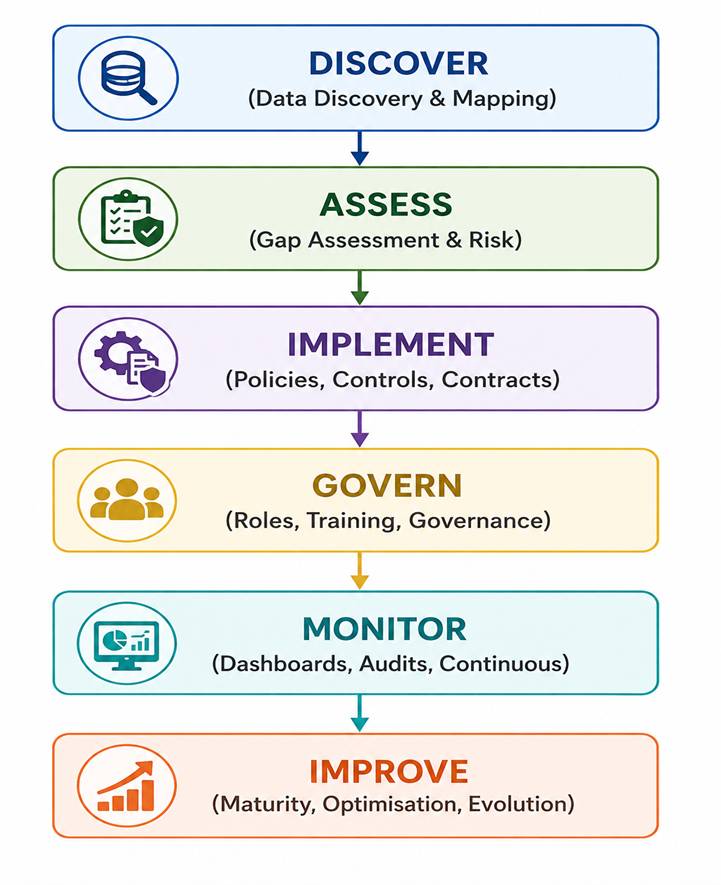
Phase 1: Discover
Data Discovery and Mapping
- Identify all personal data processing activities
- Map data flows across systems and processes
- Classify personal data by type and sensitivity
- Document processing purposes
Legal Register Foundation
- Identify all DPDPA requirements
- Map to business processes
- Assign preliminary ownership
Phase 2: Assess
Gap Assessment
- Compare current state to DPDPA requirements
- Prioritise gaps by risk and impact
- Develop remediation plan
Privacy Risk Assessment
- Identify and assess privacy risks
- Document existing controls
- Determine residual risk
- Prioritise mitigation actions
Phase 3: Implement
Policy Development
- Draft or update all required policies
- Develop procedures and workflows
- Create consent mechanisms
- Design Data Principal rights processes
Technical Controls
- Implement security safeguards
- Deploy encryption, access controls, monitoring
- Configure logging and retention
- Set up breach detection and response
Contracts
- Update vendor agreements with DPDPA clauses
- Issue DPAs to all vendors
- Review customer agreements
Phase 4: Govern
Governance Structure
- Establish privacy team
- Define roles and responsibilities
- Implement training programme
- Create reporting lines
Documentation
- Maintain Legal Register
- Evidence management system
- Compliance tracking
Phase 5: Monitor
Continuous Monitoring
- Compliance dashboard
- KPIs and metrics
- Regular reviews
- Internal audits
Incident Management
- Breach detection and response
- Notification workflows
- Post-incident review
Phase 6: Improve
Maturity Journey
- Assess current maturity
- Plan improvement path
- Implement enhancements
Optimisation
- Automate where possible
- Integrate with other compliance frameworks
- Continuous feedback loops
Final Checklist
50-Point DPDPA Readiness Checklist for SaaS Companies
Governance & Strategy (1-10)
| # | Item | Status |
| 1 | Privacy Officer or DPO appointed | ☐ |
| 2 | Cross-functional privacy team established | ☐ |
| 3 | Privacy budget allocated | ☐ |
| 4 | Compliance roadmap developed | ☐ |
| 5 | Management commitment obtained | ☐ |
| 6 | Privacy governance documented | ☐ |
| 7 | Roles and responsibilities defined | ☐ |
| 8 | Privacy committee established (if applicable) | ☐ |
| 9 | Privacy training programme developed | ☐ |
| 10 | Employee awareness communications planned | ☐ |
Legal Register & Documentation (11-18)
| # | Item | Status |
| 11 | Legal Register created and maintained | ☐ |
| 12 | Compliance Register established | ☐ |
| 13 | Evidence Register created | ☐ |
| 14 | Privacy Risk Register developed | ☐ |
| 15 | Record of Processing Activities (RoPA) created | ☐ |
| 16 | Data flow diagrams documented | ☐ |
| 17 | Data classification scheme implemented | ☐ |
| 18 | Policies and procedures documented | ☐ |
Policies & Procedures (19-26)
| # | Item | Status |
| 19 | Privacy Policy published and accessible | ☐ |
| 20 | Data Retention Policy documented | ☐ |
| 21 | Data Breach Response Policy documented | ☐ |
| 22 | Vendor Management Policy documented | ☐ |
| 23 | Data Principal Rights Policy documented | ☐ |
| 24 | Consent Management Policy documented | ☐ |
| 25 | Information Security Policy documented | ☐ |
| 26 | Employee Privacy Policy documented | ☐ |
Technical Controls (27-35)
| # | Item | Status |
| 27 | Encryption in transit implemented | ☐ |
| 28 | Encryption at rest implemented | ☐ |
| 29 | Access controls (RBAC) implemented | ☐ |
| 30 | Multi-factor authentication enabled | ☐ |
| 31 | Logging and monitoring configured | ☐ |
| 32 | SIEM or security monitoring in place | ☐ |
| 33 | Vulnerability scanning conducted | ☐ |
| 34 | Penetration testing performed | ☐ |
| 35 | Secure Software Development Lifecycle implemented | ☐ |
Data Principal Rights (36-40)
| # | Item | Status |
| 36 | Data Subject Request (DSR) portal/process exists | ☐ |
| 37 | Identity verification process implemented | ☐ |
| 38 | Rights response workflows established | ☐ |
| 39 | Request tracking system in place | ☐ |
| 40 | Response templates created | ☐ |
Consent & Cookies (41-43)
| # | Item | Status |
| 41 | Consent Management Platform deployed | ☐ |
| 42 | Cookie consent banner implemented | ☐ |
| 43 | Consent records maintained and auditable | ☐ |
Vendor Management (44-46)
| # | Item | Status |
| 44 | Vendor inventory created | ☐ |
| 45 | DPAs signed with all processors | ☐ |
| 46 | Vendor risk assessments completed | ☐ |
Incident Response (47-48)
| # | Item | Status |
| 47 | Incident response plan tested | ☐ |
| 48 | Breach notification templates ready | ☐ |
Continuous Monitoring (49-50)
| # | Item | Status |
| 49 | Compliance dashboard implemented | ☐ |
| 50 | Internal audit programme established | ☐ |
Frequently Asked Questions
Q1: What is the deadline for DPDPA compliance?
Full compliance is mandated by May 13, 2027. Some provisions (like governance and administrative rules) are already active, but enforcement of all provisions begins on this date.
Q2: Does DPDPA apply to our SaaS if we’re based outside India?
Yes, if you offer goods or services to individuals in India or process personal data of individuals in India. The DPDPA has extraterritorial reach.
Q3: What is the penalty for non-compliance?
Penalties can be up to ₹250 crore for serious violations (e.g., failure to implement security safeguards or notify breaches). There are also daily penalties of up to ₹10,000 for certain obligations.
Q4: What is a Significant Data Fiduciary (SDF)?
An SDF is a Data Fiduciary designated based on the volume and sensitivity of personal data processed. SDFs face additional obligations, including Data Protection Impact Assessments (DPIAs), appointment of a DPO, and algorithmic governance requirements.
Q5: Can we reuse ISO 27001/SOC 2 for DPDPA?
These certifications provide a strong foundation but do not automatically ensure DPDPA compliance. You need to address DPDPA-specific requirements like consent management and Data Principal rights.
Ready to achieve and sustain DPDPA compliance? Matayo 360° offers end-to-end DPDPA compliance services for SaaS companies—from assessment to continuous compliance.
📧 Email: info@matayo-ai.com
📞 Phone: +91-89719-65556
📍 Locations: India | USA | UAE | Canada
Contact us today for a free consultation and gap assessment.